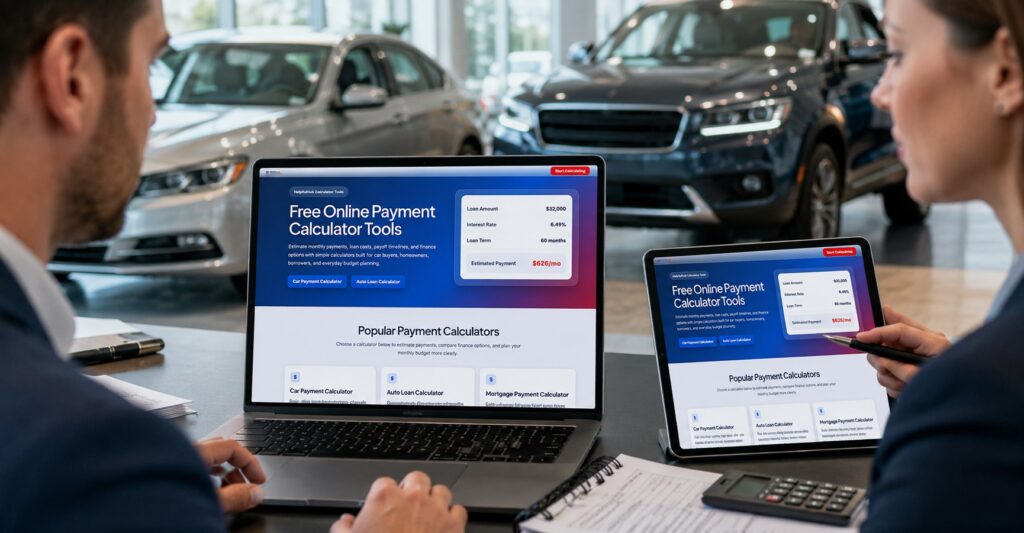
What Is a Car Payment Calculator? Complete US Buyer Guide Before Shopping
For many US buyers, that estimate can prevent expensive mistakes. A low monthly payment may look attractive, but it can hide a longer loan, more interest, negative equity, or a higher total cost. This guide explains how a car payment calculator works, how to use one correctly, and how to compare auto loan offers like a smarter buyer.
Car Payment Calculator Quick Answer
A car payment calculator estimates your monthly auto loan payment based on the vehicle price, loan amount, down payment, trade-in value, APR, loan term, and sometimes taxes and fees. It helps you understand the payment before you commit to financing.
The simplest version calculates principal and interest. A more complete car payment calculator also lets you add sales tax, registration fees, dealer fees, trade-in credit, payoff amount, and other real-world costs.
Beginners should use a calculator before shopping because it creates a payment boundary. Instead of asking, “What car do I like?” you start with, “What payment and total cost can I safely afford?” That shift can save money and reduce pressure during dealership negotiations.
What Is a Car Payment Calculator?
A car payment calculator is an online finance tool that estimates the monthly payment on a car loan. It uses a loan formula to calculate how much you may pay each month based on the amount financed, interest rate, and repayment term.
In real life, car buying is not only about the sticker price. Buyers also deal with sales tax, registration, title fees, documentation fees, dealer add-ons, rebates, manufacturer incentives, trade-in value, and possible negative equity. A strong calculator helps bring those numbers into one clear estimate.
For example, a $35,000 car does not always mean a $35,000 loan. You may put $4,000 down, trade in a vehicle worth $6,000, pay off an old loan balance, add state taxes, and include dealer fees. The calculator helps connect all of those moving parts.
This matters because auto financing decisions can last for years. A small change in APR or loan term can change the total interest by hundreds or thousands of dollars. Therefore, a calculator is not just a convenience. It is a planning tool.
How a Car Payment Calculator Works
Most auto loan payment calculators use the same basic loan payment formula. The calculator takes your loan balance, converts the APR into a monthly interest rate, and spreads repayment across the number of months in the loan term.
The formula creates a fixed monthly payment for a standard installment loan. Each payment includes interest and principal. At the beginning of the loan, more of each payment goes toward interest. Over time, more goes toward reducing the loan balance.
This process is called amortization. An auto loan amortization calculator shows how the balance falls month by month. It can also show the total interest you pay over the life of the loan.
However, a calculator is still an estimate. Your final contract depends on lender approval, vehicle price, credit score, state taxes, lender rules, dealer fees, insurance requirements, and any products you choose to add. As a result, you should treat calculator results as planning numbers, not a final approval.
Why US Buyers Should Use One Before Shopping
Many car shoppers focus on the vehicle first and the financing later. That approach can create problems. Once you fall in love with a car, it becomes harder to walk away from a payment that stretches your budget.
A car payment calculator helps you set limits before emotion takes over. It can show the difference between a car that is affordable on paper and one that fits your real monthly budget.
It also helps you compare offers. A dealership may quote a lower payment with a longer term. A credit union may offer a lower APR but require a shorter term. A bank may approve a higher loan amount but at a higher rate. The calculator helps you compare the full cost, not only the monthly number.
Before you shop, open a reliable auto finance calculator hub and test several price points. Try conservative numbers first. Then compare those estimates with your income, current bills, insurance estimate, fuel cost, and savings goals.
Main Factors That Affect Monthly Payments
Your monthly car payment depends on several key factors. Some are easy to control, such as down payment and loan term. Others depend on the market, lender, vehicle type, and credit profile.
The most important factor is the loan amount. A higher loan balance usually means a higher payment. If you reduce the loan amount through a larger down payment or stronger trade-in, your payment can drop.
APR is another major factor. Even a small APR difference can affect the payment and total interest, especially on a large loan or long term. Loan term also matters because a longer term can lower the monthly payment while raising the total cost.
Taxes and fees can surprise buyers. In many states, sales tax, title, registration, and documentation fees can add thousands to the out-the-door price. If your calculator ignores these costs, the estimate may look too low.
Car Payment Calculator Inputs Table
The best way to use a monthly car payment calculator is to understand every input. Each number changes the final estimate in a different way.
| Input | What It Means | Why It Matters |
|---|---|---|
| Vehicle Price | The selling price of the car before taxes and fees. | It creates the starting point for the loan estimate. |
| Down Payment | Cash you pay upfront. | It lowers the amount financed and can reduce monthly payments. |
| Trade-In Value | The amount the dealer or buyer gives for your current vehicle. | It can reduce the new loan amount if you have equity. |
| Trade-In Payoff | The remaining loan balance on your current car. | It can reduce equity or create negative equity. |
| APR | The annual percentage rate charged by the lender. | It affects both monthly payment and total interest. |
| Loan Term | The number of months used to repay the loan. | Longer terms lower payments but often increase total interest. |
| Sales Tax | State and local tax on the vehicle purchase. | It can add a meaningful cost to the amount financed. |
| Title and Registration | Government fees needed to register the vehicle. | They affect the total out-the-door cost. |
| Dealer Fees | Documentation or dealer-imposed charges. | They can raise the final price if not included upfront. |
Down Payment, Trade-In, and Loan Amount
The loan amount is the core number behind your monthly payment. It is not always the same as the vehicle price. It is the amount you finance after adjustments.
A simple way to think about it is this: vehicle price plus taxes and fees, minus down payment, minus trade-in equity, plus any negative equity. That result becomes the estimated loan amount.
A down payment gives you instant leverage. If you put more money down, you borrow less. That can reduce the monthly payment, lower total interest, and improve your chance of approval.
Trade-in value works in a similar way when you have equity. For example, if your trade-in is worth $12,000 and you owe $8,000, you have $4,000 in equity. That $4,000 can reduce the next loan.
On the other hand, negative equity increases the next loan. If your car is worth $12,000 and you owe $16,000, you are $4,000 upside down. Rolling that amount into the new loan raises the payment and increases risk.
Use a car payment calculator with trade in before accepting a dealership offer. It helps you see whether the trade-in actually improves the deal or simply hides extra debt inside a new payment.
Interest Rate, APR, and Credit Score
APR is one of the most important parts of auto financing. It represents the yearly cost of borrowing, including interest and certain finance-related costs. A lower APR usually means a lower payment and less total interest.
Your credit score often has a major impact on APR. Buyers with strong credit may qualify for lower rates. Buyers with weaker credit may face higher rates, larger down payment requirements, or shorter approval options.
However, credit score is not the only factor. Lenders may also consider income, debt-to-income ratio, employment history, vehicle age, loan-to-value ratio, loan term, and the amount financed.
| Credit Score Range | Possible APR Impact | Buyer Tip |
|---|---|---|
| Excellent Credit | Often qualifies for stronger rates and more flexible terms. | Compare bank, credit union, and dealer offers before choosing. |
| Good Credit | May receive competitive rates but still should shop around. | Use preapproval to create negotiation power. |
| Fair Credit | May receive higher APR offers and stricter loan terms. | Test a few APR scenarios before visiting the dealer. |
| Poor Credit | May face high APR, larger down payment needs, or limited lenders. | Focus on affordability, shorter loan risk, and total cost. |
| No Credit or Thin Credit | May need a co-signer, larger down payment, or starter loan. | Choose a conservative vehicle price and avoid overborrowing. |
A car payment calculator by credit score cannot guarantee your exact rate. Still, it can help you model a realistic range. For example, test 6%, 9%, 12%, and 18% APR to see how much credit strength can change the payment.
48, 60, 72, and 84 Month Car Loans
Loan term is the number of months you take to repay the auto loan. Common US auto loan terms include 48, 60, 72, and 84 months. Each term changes the payment and the total interest.
A shorter loan term usually creates a higher monthly payment. However, it can lower total interest and help you build equity faster. A longer term can make the payment feel easier, but it may increase total cost and negative equity risk.
| Loan Term | Monthly Payment Impact | Total Interest Impact | Best For |
|---|---|---|---|
| 48 Months | Higher monthly payment. | Usually lower total interest. | Buyers who want faster payoff and lower long-term cost. |
| 60 Months | Balanced payment for many buyers. | Moderate total interest. | Buyers who want a practical middle ground. |
| 72 Months | Lower monthly payment. | Higher total interest. | Buyers who need flexibility but still track total cost. |
| 84 Months | Lowest payment among these examples. | Often much higher total interest. | Buyers who understand long-term risk and plan carefully. |
Use a car payment calculator 48 vs 60 vs 72 months comparison before you choose a loan. The best term is not always the one with the smallest payment. Instead, the better choice is the one that fits your cash flow without creating unnecessary long-term debt.
Taxes, Title, Registration, and Dealer Fees
Taxes and fees can change your payment more than many buyers expect. A vehicle with a $30,000 selling price may have a much higher out-the-door cost after sales tax, title, registration, destination charge, documentation fee, and other charges.
Sales tax rules vary by state and sometimes by city or county. Some states tax the full price. Others may treat trade-in credits differently. Registration and title fees also vary by state.
Dealer fees need close attention. Some fees may be mandatory, while others may be optional products or add-ons. Examples can include documentation fees, dealer preparation fees, protection packages, service contracts, tire and wheel plans, and gap coverage.
A car payment calculator with taxes and fees gives a better estimate than a calculator that only uses vehicle price. For a more realistic result, add taxes, registration, title, and dealer fees before you compare payments.
| Cost Item | Included in Loan? | Buyer Note |
|---|---|---|
| Sales Tax | Often yes, if financed. | Use your state and local rate for a better estimate. |
| Title Fee | Sometimes yes. | It is usually a government-related cost. |
| Registration Fee | Sometimes yes. | It can vary by state, vehicle type, weight, or value. |
| Documentation Fee | Often yes. | Ask whether it is included in the advertised price. |
| Destination Charge | Often yes. | New vehicles often include this charge on the window sticker. |
| Optional Add-Ons | Only if you choose them. | Review each product and decide if it adds real value. |
| Insurance | Usually no. | Budget for it separately before buying. |
New Car vs Used Car Payment Calculator
A new car payment calculator and a used car payment calculator use the same basic loan logic. However, the buying details can differ. New cars may qualify for manufacturer incentives, promotional APRs, rebates, or special financing. Used cars may have lower prices but higher APRs depending on age, mileage, and lender rules.
New vehicles also lose value quickly during early ownership. Used vehicles may already have passed through the steepest depreciation period. However, used cars can bring higher maintenance risk, shorter warranty coverage, and higher inspection needs.
| Factor | New Car | Used Car |
|---|---|---|
| Purchase Price | Usually higher. | Usually lower. |
| APR Offers | May include promotional financing. | May be higher based on age and mileage. |
| Warranty | Usually stronger factory coverage. | May have limited or expired coverage. |
| Depreciation | Often faster in early years. | May depreciate more slowly after initial drop. |
| Maintenance Risk | Usually lower at first. | Can be higher depending on condition. |
| Best Use of Calculator | Compare MSRP, rebates, APR, and fees. | Compare price, APR, inspection cost, and warranty needs. |
When comparing new and used options, do not only compare monthly payments. Also compare total interest, insurance, expected maintenance, warranty coverage, and resale value outlook.
First-Time, Good Credit, and Bad Credit Buyers
Different buyers should use a car payment calculator in different ways. A first-time buyer may need a basic monthly payment estimate. A good-credit buyer may use the tool to compare lender offers. A bad-credit buyer may use it to avoid unaffordable high-interest loans.
First-time buyers should start with a conservative budget. Add insurance estimates early because new drivers may face higher premiums. Also leave room for fuel, maintenance, parking, tolls, and emergency repairs.
Good-credit buyers should not assume the first offer is the best one. Even with strong credit, it makes sense to compare a bank, credit union, online lender, and dealership finance quote. A small APR difference can matter over a long term.
Bad-credit buyers should pay special attention to total interest. A high APR can turn a modest vehicle into a very expensive loan. In addition, long terms at high rates can increase negative equity risk.
In every case, the calculator should support decision-making. It should not be used to justify a payment that already feels uncomfortable.
Practical Car Payment Calculation Examples
Examples make auto financing easier to understand. The numbers below are simplified for education. Your actual payment will depend on lender approval, state taxes, fees, and contract details.
Example 1: New Car Payment Estimate
Assume a buyer chooses a new car with a $36,000 selling price, $4,000 down payment, 7% APR, and a 60-month term. Before taxes and fees, the estimated financed amount is $32,000.
The monthly payment would be based on that $32,000 balance, the monthly interest rate, and 60 payments. If the buyer adds taxes and fees to the loan, the payment will rise. That is why a full estimate should include the out-the-door price.
Example 2: Used Car Payment Estimate
Now assume a used SUV costs $24,000. The buyer puts $2,500 down and qualifies for 10% APR over 60 months. The lower price helps, but the higher APR increases the finance cost.
This is where a used car payment calculator becomes useful. It lets the buyer test whether a lower-priced used vehicle still makes sense after adding a higher interest rate, inspection cost, and possible maintenance budget.
Example 3: Calculation With Trade-In
Assume a buyer purchases a $38,000 vehicle and trades in a car worth $10,000. The old loan payoff is $7,000, so the trade-in equity is $3,000. If the buyer also puts $2,000 down, the purchase balance drops by $5,000 before taxes and fees.
That can lower the payment. However, if the payoff were $12,000 instead, the buyer would have $2,000 in negative equity. That amount could increase the new loan if rolled into financing.
Example 4: Calculation With Taxes and Fees
A $30,000 car may become a higher financed amount after tax, title, registration, destination charge, and dealer fees. If these costs add $3,000 and the buyer makes a $3,000 down payment, the loan may still remain close to $30,000.
This surprises many shoppers. They think the down payment will reduce the payment sharply, but taxes and fees may offset part of that benefit.
Example 5: Bad Credit APR Scenario
A buyer with a higher APR should test multiple loan terms before signing. For example, a long loan at a high APR may lower the payment but add significant total interest. A cheaper vehicle with a larger down payment may create a safer path.
Before applying, use the monthly car payment calculator to test payment changes at several APR levels. Try one realistic rate, one slightly better rate, and one worse rate. That range gives you a clearer plan.
How Much Car Can You Afford?
A car payment calculator estimates the loan payment. A car affordability calculator looks at your full financial picture. Both are useful, but they answer different questions.
The payment calculator asks, “What would this loan cost each month?” The affordability calculator asks, “Can this payment fit safely inside my budget?” Smart buyers use both.
Start with your monthly take-home income. Then list rent or mortgage, utilities, food, insurance, debt payments, phone bills, savings, and personal expenses. After that, decide how much room remains for transportation.
Remember that transportation cost is more than the loan payment. You also need insurance, fuel or charging, maintenance, registration, tires, repairs, and parking. If the loan payment uses the entire transportation budget, the car is probably too expensive.
A good rule is to leave breathing room. Life changes. Insurance can rise. Repairs can happen. Fuel prices can move. A safe estimate gives you flexibility instead of stress.
Monthly Payment vs Total Ownership Cost
Monthly payment is only one part of car ownership. A low monthly payment may look comfortable, but it does not always mean the vehicle is affordable. Total ownership cost gives a more complete picture.
Total ownership cost includes loan payment, insurance, fuel or electricity, maintenance, repairs, registration, taxes, depreciation, and sometimes parking or tolls. Trucks, SUVs, luxury vehicles, and performance cars may cost more to insure and maintain.
For example, two vehicles may have the same monthly loan payment. However, one may require premium fuel, expensive tires, higher insurance, and costly repairs. The other may be cheaper to own over time.
This is why a car payment calculator with insurance estimate and ownership cost can be helpful. If your calculator does not include those items, add them separately in your personal budget.
How to Compare Auto Loan Offers
Car buyers should compare loans by more than payment. The right comparison includes APR, loan term, total interest, fees, prepayment rules, lender reputation, and total amount paid.
A bank loan may offer stability and clear terms. A credit union may offer competitive rates and member-friendly service. Dealership financing may be convenient and sometimes includes manufacturer promotions. However, convenience does not always mean the lowest cost.
| Financing Source | Pros | Cons | Best For |
|---|---|---|---|
| Bank Auto Loan | Established lenders and clear loan products. | Rates may vary by credit and relationship. | Buyers who want traditional financing. |
| Credit Union Loan | Often competitive rates and member-focused service. | Membership may be required. | Buyers who can qualify for membership. |
| Dealership Financing | Convenient and may offer manufacturer incentives. | Terms can vary, so comparison is important. | Buyers comparing promotional APR or rebate offers. |
| Online Lender | Fast prequalification and easy comparison. | Final terms may depend on verification. | Buyers who want quick rate shopping. |
| Refinance Lender | May lower payments or interest after purchase. | May extend debt if used carelessly. | Owners with improved credit or better rate options. |
Use an auto loan payment calculator to compare each offer using the same vehicle price and down payment. Then compare the total interest, not only the monthly payment.
How to Use a Calculator Before Visiting a Dealership
A calculator gives you a stronger position before you enter a dealership. It helps you know your target price, payment range, loan term, and maximum out-the-door cost.
Start by choosing a realistic vehicle price. Add estimated taxes and fees. Then test different down payments and loan terms. Save the results or write down your target numbers.
Next, get preapproved if possible. Preapproval can show an estimated APR and loan limit. It also gives you a comparison point if the dealership offers financing.
At the dealership, avoid negotiating only around monthly payment. A salesperson may make the payment fit by extending the term, increasing the down payment, or adding costs elsewhere. Instead, negotiate the vehicle price, trade-in value, APR, fees, and total amount financed.
Use the calculator during the process. If a dealer changes the price, term, or fee structure, update your estimate. This keeps the deal transparent.
Rebates, Incentives, and Negative Equity
Rebates and manufacturer incentives can reduce the purchase cost. A cash-back offer may lower the amount financed. A promotional APR may reduce interest. However, the best offer depends on the full deal.
Sometimes buyers must choose between a rebate and a special APR. The lower payment is not always obvious. Use a calculator to compare both options.
Negative equity needs even more caution. Rolling old debt into a new loan can make the new vehicle more expensive from day one. It can also increase the chance that you owe more than the car is worth.
If you have negative equity, consider delaying the purchase, paying down the old loan, choosing a less expensive vehicle, or adding a larger down payment. A car payment calculator with negative equity can show how much the old balance affects the new payment.
Refinancing, Extra Payments, and Early Payoff
Auto loan refinancing replaces your current car loan with a new loan. It may lower your monthly payment, reduce your APR, change your loan term, or help you pay off the vehicle faster.
Refinancing can help when your credit has improved, market rates have changed, or your original loan was not competitive. However, it can also increase total cost if you extend the loan too far.
Extra payments can reduce interest and shorten the payoff timeline. Even a small extra principal payment can help if your lender applies it correctly. Before paying extra, confirm whether the lender charges prepayment penalties or applies extra money to principal.
Biweekly payments are another strategy. Instead of one monthly payment, you pay half the amount every two weeks. This can create the effect of one extra monthly payment per year. However, make sure your lender processes the payments in a way that actually helps reduce the loan faster.
A car payment calculator with extra payments or payoff schedule can help you estimate the benefit. Use the main calculator first, then test refinance and early payoff scenarios inside a trusted calculator hub.
EVs, Trucks, SUVs, and Family Vehicles
Different vehicle types create different payment and ownership patterns. Electric vehicles, pickup trucks, SUVs, and family cars each need a slightly different calculator mindset.
EV buyers should consider purchase price, charging setup, electricity cost, insurance, battery warranty, and available incentives. Federal and state incentives can change, so buyers should verify current rules before relying on any tax credit estimate.
Truck buyers should pay attention to trim level, engine, towing package, payload needs, fuel economy, tires, and insurance. A truck with the same monthly payment as a sedan may still cost more to own.
SUV and family car buyers should think about safety features, seating needs, cargo room, child-seat space, insurance, and long-term reliability. A slightly higher payment may be reasonable if the vehicle fits family needs and avoids a second purchase later.
For online car buying, a calculator is even more important. Digital listings make it easy to compare vehicles quickly, but they may not always show the full out-the-door cost upfront. Add taxes, fees, shipping, trade-in payoff, and financing assumptions before you decide.
Common Calculator Mistakes
A calculator is useful only when the inputs are honest. If you enter unrealistic numbers, the result may mislead you. The most common mistakes come from ignoring taxes, stretching the loan too far, or using an APR that is too optimistic.
| Mistake | Why It Hurts | Better Approach |
|---|---|---|
| Using only the sticker price. | It ignores taxes, title, registration, and dealer fees. | Use the out-the-door price when possible. |
| Choosing the longest term for the lowest payment. | It may raise total interest and negative equity risk. | Compare 48, 60, 72, and 84 months side by side. |
| Ignoring APR differences. | A small rate change can affect total cost. | Test several APR scenarios before shopping. |
| Forgetting insurance cost. | The car may fit the loan budget but not the ownership budget. | Get an insurance estimate before buying. |
| Overvaluing the trade-in. | The final payment may rise if the offer is lower than expected. | Check multiple trade-in estimates before negotiating. |
| Rolling negative equity without testing it. | It increases the new loan and can create long-term debt pressure. | Calculate the payment with and without negative equity. |
| Focusing only on monthly payment. | It can hide a costly loan structure. | Review total interest and total amount paid. |
Also watch for optional add-ons. Some products may be useful for certain buyers, but others may not be worth financing. If an add-on is included in the loan, it increases your payment and may add interest over time.
Future Trends in Car Payment Calculators
Car payment calculators are becoming more advanced. In the past, many tools only estimated principal and interest. Today, better tools include taxes, fees, trade-ins, payoff amounts, incentives, and ownership costs.
Future calculators will likely become more personalized. They may include insurance estimate ranges, real-time lender prequalification, EV charging cost estimates, depreciation forecasts, and maintenance projections.
AI-powered calculators may also help buyers compare vehicles based on lifestyle. For example, a family buyer may see payment, insurance, fuel, and cargo practicality in one dashboard. A commuter may compare EV charging cost against gas cost. A truck buyer may compare towing needs with monthly cost.
However, smarter tools do not remove the need for buyer judgment. A calculator can organize the numbers, but you still need to decide what payment fits your life.
Final Auto Loan Checklist
Before choosing an auto loan, review the full deal. A good payment is not enough. The loan should also make sense over the full ownership period.
| Checklist Item | Why It Matters | Smart Buyer Action |
|---|---|---|
| Vehicle Price | It drives the entire loan estimate. | Negotiate the selling price before focusing on payment. |
| Out-the-Door Cost | It includes taxes and fees. | Ask for a full written breakdown. |
| APR | It affects payment and interest. | Compare multiple lenders. |
| Loan Term | It changes monthly and total cost. | Avoid choosing a long term only to force affordability. |
| Trade-In Equity | It can lower or raise the next loan. | Know your payoff and market value. |
| Insurance Estimate | It affects total monthly car cost. | Quote insurance before signing. |
| Total Interest | It shows the real borrowing cost. | Use an amortization estimate. |
| Optional Products | They can increase financed cost. | Accept only what you understand and value. |
For a fast final check, run the numbers again in a car loan calculator USA before signing. Then compare the result with the finance contract.
FAQ About Car Payment Calculator
What is a car payment calculator?
A car payment calculator is a tool that estimates your monthly auto loan payment based on loan amount, APR, loan term, down payment, trade-in value, and sometimes taxes and fees.
Is a car payment calculator accurate?
It can be accurate as an estimate if you enter realistic numbers. The final payment still depends on lender approval, dealer fees, state taxes, and the final contract.
What information do I need before using a car payment calculator?
You need the vehicle price, estimated down payment, trade-in value, payoff amount, APR, loan term, sales tax, registration fees, title fees, and dealer fees.
How does down payment affect monthly car payment?
A larger down payment lowers the amount financed. As a result, it usually lowers the monthly payment and total interest.
How does trade-in value affect a car loan?
Positive trade-in equity can reduce your new loan. Negative equity can increase it if you roll the old balance into the new loan.
What is the difference between APR and interest rate?
The interest rate is the cost of borrowing money. APR is a broader annual cost measure that may include certain finance charges. For loan comparison, APR is usually the better number to review.
Is a 72-month car loan bad?
Not always, but it can increase total interest and negative equity risk. Compare it with a 60-month term before choosing.
Is an 84-month car loan risky?
It can be risky because the loan lasts longer, total interest may be higher, and the car may lose value faster than the loan balance falls.
Should I use a new car payment calculator or used car payment calculator?
Use the calculator that matches your purchase. New cars may include rebates or promotional APRs. Used cars may need higher APR, inspection, and maintenance assumptions.
Can I calculate car payments with taxes and fees?
Yes. A stronger calculator lets you include taxes, title, registration, dealer fees, and other costs. This creates a more realistic estimate.
How much car can I afford?
You can afford a car when the loan payment and total ownership costs fit your monthly budget without hurting savings, emergency funds, or required bills.
Does credit score affect car payments?
Yes. Credit score can influence the APR you receive. A higher APR usually creates a higher payment and more total interest.
Can a car payment calculator help with bad credit?
Yes. It helps bad-credit buyers test higher APR scenarios, compare down payments, and avoid loans that look affordable only because of long terms.
Can I use a calculator for refinancing?
Yes. A refinance calculator can estimate whether a new APR or term may lower your monthly payment or reduce total interest.
Do car payment calculators include insurance?
Some do, but many do not. If insurance is not included, get a separate quote and add it to your monthly transportation budget.
Do EV tax credits reduce car payments?
They can reduce the effective purchase cost if you qualify and the program is available. However, incentive rules can change, so always verify current federal, state, and dealer-specific details before relying on an estimate.
What is the best way to compare loan offers?
Compare APR, term, monthly payment, total interest, fees, and total amount paid. Do not choose based only on the lowest monthly payment.
Should I calculate payments before visiting a dealership?
Yes. It gives you a realistic budget and helps you avoid pressure. It also helps you recognize when a deal changes through fees, term length, or add-ons.
What is the biggest mistake buyers make?
The biggest mistake is focusing only on monthly payment. A low payment can hide a longer term, higher total interest, or extra costs.
Where can I calculate my estimated car payment?
You can start with a dedicated car payment calculator with interest, down payment, trade-in, taxes, and fees. For related tools, you can also visit the HelpfulHub calculator homepage.
Final Recommendation
A car payment calculator is one of the simplest tools a US car buyer can use before shopping. It helps you estimate monthly payments, compare loan terms, understand APR impact, include taxes and fees, and avoid overpaying for auto financing.
Use it early, before you visit a dealership or apply for financing. Test several prices, down payments, APRs, and loan terms. Then compare the monthly payment with the full cost of ownership.
Overall, the smartest buyer does not chase the lowest payment. The smartest buyer understands the full loan, the total interest, the out-the-door price, and the real monthly cost of owning the vehicle. That is exactly where a reliable car payment calculator can help.